What is Defect Density
Posted By : Pratiksha Saxena | 02-Feb-2015
Defect Density is estimated as the number of defects found in a component or softaware divided by the size of that component or system.In basic measurement terms, it determines lines-of-code,or the number of classes or function points in a programgm.Defect Density is a measure of the total known defects divided by the size of the software item being measured.Formula is-
Defect Density= Number of known defects/software size
The number of defects can be found by calculating the total defects found across a particular software item during a specific period of time. Number of defects which are found during different time pause, can be classified as-
1. Defects which are found from the creation of the software module till the date.
2. Defects which are found in a program at the time of Inspection.
3. Defects which are found from the delivery of a software release to the client till the date.
Identifying defect prone components allows the concentration of definite resources into areas with the highest promising return on the investment.
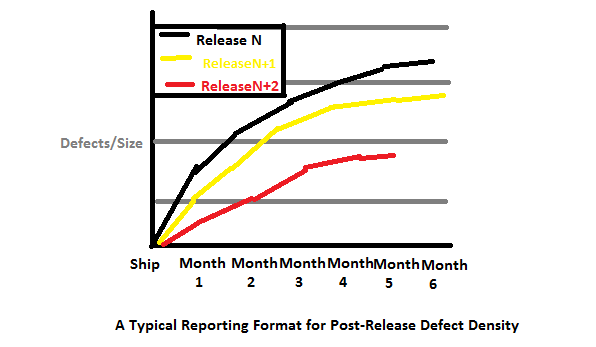
There is one other use of defect density,it is used to compare consecutive releases of a product to track the impact of defect reduction and quality improvement activities.Calculating post-release defect density allows product release of varying size to be compared.Differences between products can also be compared in this manner. Figure illustrates a typical reporting format for post –release defect density:
Thanks


Cookies are important to the proper functioning of a site. To improve your experience, we use cookies to remember log-in details and provide secure log-in, collect statistics to optimize site functionality, and deliver content tailored to your interests. Click Agree and Proceed to accept cookies and go directly to the site or click on View Cookie Settings to see detailed descriptions of the types of cookies and choose whether to accept certain cookies while on the site.















About Author
Pratiksha Saxena
Pratiksha is a QA Engineer with skills in Manual Testing